
How Funnel Disruption and Weak Communication Reduce University Admission Percentage
Dharmveer
3/14/20263 min read
Introduction
In the modern higher education landscape, attracting student leads is no longer the biggest challenge for universities. The real challenge lies in converting those leads into confirmed admissions.
Many institutions generate thousands of inquiries through digital marketing campaigns, education fairs, and website registrations. However, a significant percentage of these leads fail to convert into enrollments.
One of the biggest reasons behind this problem is admission funnel disruption and weak communication strategies.
When the admission funnel is not properly managed, potential students lose interest, shift to competing universities, or simply stop responding.
Understanding how funnel disruptions impact enrollment is essential for improving admission conversion rates.
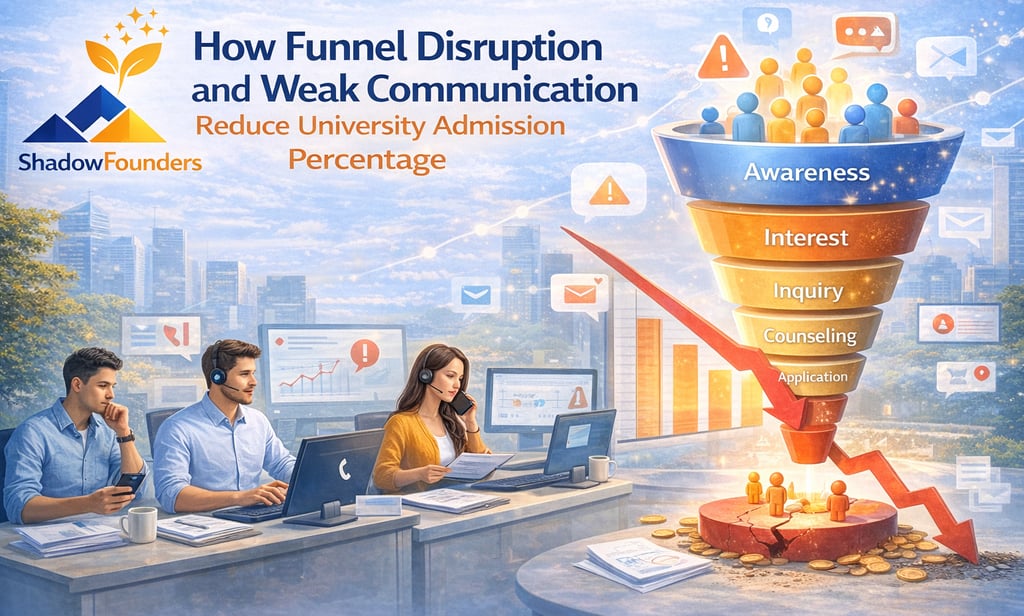
What is an Admission Funnel?
The admission funnel represents the journey a prospective student takes before enrolling in a university.
The funnel usually consists of several stages:
Awareness – The student learns about the university.
Interest – The student explores programs and opportunities.
Inquiry – The student submits a lead form or admission inquiry.
Counseling – The admission team communicates with the student.
Application – The student applies for admission.
Enrollment – The student confirms admission and pays the fee.
Any weakness at these stages can significantly reduce the overall admission percentage.
How Funnel Disruption Reduces Admission Conversion
1. Slow Response to Student Inquiries
In the digital era, students expect instant responses.
If universities take 24–48 hours to respond to a student inquiry, the student may already have contacted multiple institutions.
Research in lead management shows that responding within 5 minutes increases conversion probability dramatically.
Delayed responses break the momentum of the admission funnel.
2. Poor Lead Management Systems
Many universities collect thousands of leads but lack proper CRM systems or structured follow-up processes.
Without systematic tracking, admission teams may:
Miss follow-up calls
Lose important student data
Fail to nurture leads properly
This leads to a high lead drop-off rate.
3. Weak Counselor Communication
Admission counselors play a critical role in influencing student decisions.
However, weak communication can reduce enrollment probability.
Common communication issues include:
Lack of personalized counseling
Incomplete program information
Poor explanation of career opportunities
Unprofessional follow-up
Students and parents expect clear, confident, and informative guidance during the admission process.
4. Lack of Trust Building
Education is a high-investment decision.
Students and parents want reassurance about:
Placement opportunities
Faculty quality
Infrastructure
Career outcomes
If universities fail to communicate these aspects effectively, students often choose competitors.
Impact of Weak Communication on Admissions
Weak communication creates several problems within the admission funnel:
Lower Student Engagement
Students lose interest if they feel ignored or poorly informed.
Increased Competition Loss
If communication is weak, competing universities can easily convert the same student.
Reduced Brand Perception
Poor communication damages the overall reputation of the institution.
Signs Your Admission Funnel Is Broken
Universities should regularly analyze their funnel performance.
Warning signs include:
High inquiry numbers but low admission rates
Students not answering follow-up calls
High drop-off after counseling
Low application completion rate
Poor counselor productivity
These indicators suggest serious funnel inefficiencies.
Strategies to Improve Admission Funnel Conversion
1. Implement a Strong CRM System
A structured CRM system helps universities track every student interaction.
It enables:
Automated follow-ups
Lead tracking
Counselor performance monitoring
Data-driven decision making
2. Train Admission Counselors
Counselors should be trained in:
Communication skills
Program knowledge
Career counseling
Handling student objections
A confident counselor significantly increases admission conversion.
3. Automate Lead Response Systems
Automated systems such as:
WhatsApp responses
Instant email replies
Chatbots
ensure that every student receives an immediate response.
4. Strengthen Digital Communication
Universities should use multiple channels to nurture leads:
Email marketing
WhatsApp updates
Webinar sessions
Student testimonial videos
These touchpoints help build trust throughout the admission journey.
The Role of Data in Admission Funnel Optimization
Data analytics helps universities understand where the funnel is breaking.
Important metrics include:
Lead-to-counseling ratio
Counseling-to-application ratio
Application-to-admission ratio
Counselor conversion rate
Tracking these metrics helps institutions identify weaknesses and improve performance.
Conclusion
Generating student leads is only the first step in the admission process. The real success lies in efficiently managing the admission funnel and maintaining strong communication with prospective students.
Universities that focus on lead nurturing, counselor training, and structured communication strategies can significantly improve their admission conversion rates.
In today’s competitive education environment, institutions that optimize their admission funnel will gain a major advantage in attracting and enrolling high-quality students.